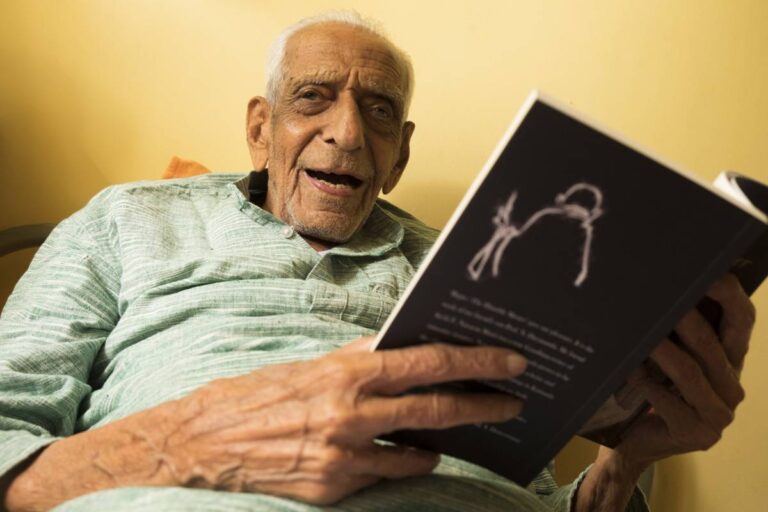

H S Doreswamy
When I was in class 5, I read a book “My Early Life” by Mahatma Gandhi and I was fascinated by it. I did not understand it then but much later understood its significance. ‘Harijaan,’ a weekly tabloid run by Mahatma Gandhiji carried news and his views which evoked the sense of freedom. I used to attend public gatherings which had speakers who showed us the meaning of freedom. They invoked a thirst within us and inspired us. These are the inspirations that made me fight for our freedom.
1936. There was a public meeting calling for independence. A huge crowd gathered and the police showed up as well. That was the first time I was part of a lathi charge.
1942. I took part in the Quit India Movement. Students played an important role in the protests. Two freedom fighters, Sardar K A Venkat Ramaiah and AG Ramachandra, came and asked if my brother and I would be the face of the protests since they had to go underground. We agreed. Our objective was to hinder any activity that aided British in the ongoing war. So we decided to organise a labour strike. We targeted three textile mills that manufactured parachute cloths for the aeroplanes. There were 8000 labourers across the three mills, but their leader was hesitant to cooperate. I spoke to him. “The way the people have woken up now, they never will again. We don’t know when we will get the opportunity next. Think of our motherland” It struck a chord in him and the next day he announced his support. For fourteen days, the mills were closed.
Next, we began making time bombs. They were not dangerous to humans. We targeted post boxes and government offices, which had official communication and documents. One day, a friend of mine got caught. He was beaten black and blue, and finally told them my name. I was arrested as well and jailed. I was terrified and thought I’d die. I was 24 years old and it was December 1942. I was held in detention for fourteen months in Central Jail, Bangalore. There were five hundred other people. There were thirty of us to a barrack and each of us got a stone slab, pillow, mat, bed-sheet and there was one toilet attached.
Jail was interesting. Between1930 and 1946, January 26th was celebrated as Independence Day to promulgate and commemorate the declaration of Purna Swaraj. In 1943, we managed to get a flag in the jail. Before we could hoist it, the jailer and warden began hitting people, but we managed to pull the rope. We weren’t given food that day. One day, around 1230 am, we were woken up by the sound of some men loudly saying the slogan “Bharat Mata Ki Jai -Mahatma Gandhi ki Jai”. We heard that a group of 14 military officers who were set to join Subash Chandra Bose’s Indian National Army, were caught in Calcutta and got to the jail. The Britishers wanted them to be hanged but the jail rules said only two people can be hanged in one day. So they took them back to Jalahalli Military Camp and made them stand in a row and shot them simultaneously. Before they were taken away, they gave us a letter, written in their own blood. “We need
to be ready to shed blood for the sake of our motherland…We want you to take the moment forward.”
In April 1944, they began releasing us. I moved to Mysore, failed at the soft timber business, and began a publication and book stall. In one year I moved back to Bangalore as the editor of Pauravani. When the 1947 movement began, I converted the weekly into a daily.
At Pauravani, we had a policy to not take ads from cinema, tobacco or alcohol. We only published articles about the freedom struggle. One day, we were told we needed the Chief Secretary’s approval to publish. I did not pay them any heed and published away, even adding a box saying we condemned their regulation. I knew it was a matter of time before I got arrested, so I changed locations. I got permission to be the editor of five publications from an unsuspecting collector, and began work again. We ran out of papers and I asked The Indian Express and The Hindu for paper and they sent us a lorry full. I ran it for 35 days. And then it was 1947. I was 29 years old. 15th August, 1947 is etched in my memory. People decorated their homes, put rangoli and hoisted flags in the ground.
In my days, we had only one vision, freedom and there are many who have sacrificed their lives for our Freedom. Today, I don’t know if people value the freedom. Machines have replaced people, unemployment has increased, science and technology have growth but people are poorer. We need to teach our people self-sufficiency, empower him with a source of food, he is self-sufficient!